
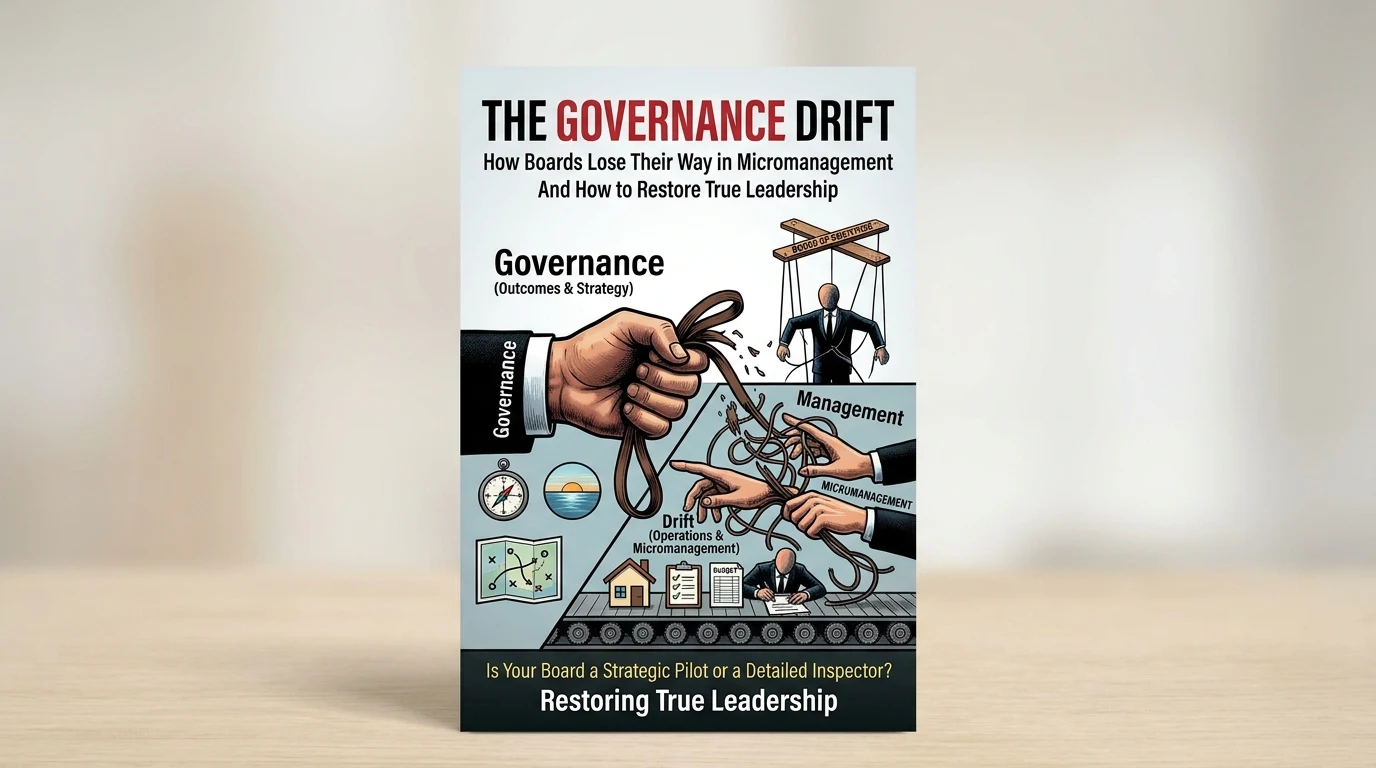
One of the biggest lies in the community sector is that good governance means boards making lots of decisions.
Bollocks.
Good governance isn’t about making decisions. It’s about deciding who gets to make them—and then actually letting people do the job without breathing down their neck.
Boards Drift Into Management
Yet watch what happens across our sector week after week. Boards sign off on marketing slogans, conference run-sheets, stakeholder emails, recruitment shortlists, logo tweaks, office fit-outs, consultation plans and project timelines, all while patting themselves on the back for “doing governance.” They haven’t governed anything. They have quietly drifted into management, and half the time they don’t even clock it because micromanaging feels busy, visible and safe.
Here’s the ugly truth: the more operational decisions a board makes, the less accountable the whole place becomes.
A board approves a budget. It shouldn’t be signing off on every purchase order out of it.
A board approves a communications framework. It shouldn’t be red-penning newsletters.
A board approves a facilities strategy. It shouldn’t be arguing over signage, chairs or paint swatches.
A board approves a strategic plan. It shouldn’t be ripping up the rollout plan every eight weeks because someone had a thought in the shower.
The board’s job isn’t to run the organisation.
Its job is to make sure the organisation is run well.
Sounds dead simple, doesn’t it? In practice, it’s where half the sector falls in a heap.
Everyone’s in the Kitchen, Nobody’s Cooking
The moment a board starts approving individual spends rather than setting budgets and delegations, management stops owning money decisions. The moment a board starts vetting comms, management stops owning relationships. The moment a board starts rewriting consultation methods, management stops owning engagement. And once a board jumps in to “fix” an operational hiccup, it quietly swallows ownership of that problem—whether it meant to or not.
Before long, nobody knows who holds the wheel.
The board thinks management is carrying out board calls.
Management thinks the board already made the call.
Staff are left dodging mixed signals, back-channelling and mystery authority.
Everyone’s in the kitchen.
Nobody’s cooking—or taking the blame when dinner burns.
Poor governance is often organisational anxiety masquerading as diligence.
The strange thing about all of this is that it is almost always done in the name of reducing risk. Boards become more involved because they are worried. CEOs become more cautious because scrutiny increases. Funders ask for more oversight because they want assurance. Nobody intends to weaken leadership. Yet somehow every extra approval, every additional committee, every extra sign-off slowly moves decision-making away from the people closest to the work. Organisations convince themselves they are becoming safer when, in reality, they are becoming slower, less adaptive, and less accountable.
Staff Own Process, the Board Owns Outcomes
Perhaps the most dangerous misunderstanding is believing boards are responsible for process.
They’re not.
Staff own process.
Management owns process.
The board owns outcomes.
The board owns risk.
The board owns strategy.
The board owns accountability.
Too many boards think they’re governing when they’re really just supervising how staff do their jobs. They get tangled up in the mechanics instead of checking whether the work actually landed.
When Boards Design the Process
Let’s rewrite the survey.
Let’s change the workshop format.
Let’s sign off on the facilitation plan.
Let’s vet the stakeholder list.
When a board starts deciding how consultations will run, how workshops will be facilitated, how projects will be delivered or how stakeholder engagement will occur, it isn’t strengthening governance.
It is weakening accountability.
Because once the board starts designing the process, who actually owns it when the process fails?
The manager?
The CEO?
The committee?
The board?
The answer becomes everybody and nobody.
When directors micromanage methods, they mistake having a life history or a pet theory for having current operational smarts. Knowing how you ran a project ten years ago—or liking a particular format—is not the same as knowing what works on the ground today.
Good governance asks:
“Did management achieve the outcome?”
Poor governance asks:
“Did management follow the process I personally would have used?”
One is accountability.
The other is micromanagement in a governance costume.
Old Grudges and Personal Hobbyhorses
And half the time, that “process” obsession isn’t even about the work in front of them—it’s old history dragging its heels into the boardroom. A director still nursing a sore spot from a past restructure, a bruised ego from a rejected idea years back, or an old feud with a partner or former staffer can turn a routine item into a proxy fight. Nobody puts “unprocessed grudge from 2019” on the agenda, so it shows up wearing a high-visibility vest called “due diligence” or “risk oversight.”
Worse still is when individual directors treat the board table as a personal hobbyhorse or a collection of single-issue champions rather than one collective governing body. One director pushes their pet project. Another pulls a side-quest into every item. Suddenly the board isn’t acting as a single steward of the whole organisation—it’s a tug-of-war of personal preferences and unfinished business.
And then there’s the flip side—just as toxic, just as common.
The Executive Who Hides Behind the Board
The CEO or senior manager who hides behind the board.
Every seasoned director has heard the script.
Why wasn’t there real consultation?
“The Board decided.”
Why are we pivoting again?
“The Board decided.”
Why did that partnership blow up?
“The Board decided.”
Why hasn’t that complaint gone anywhere?
“The Board decided.”
Do that often enough and it stops looking like governance and starts looking like cowardice. It turns the board into a human shield against pushback, hard conversations and awkward trade-offs.
Boards don’t exist to absorb executive excuses.
A board sets direction.
An executive owns leadership.
An executive owns communication.
An executive owns delivery.
An executive owns relationships.
Passing the buck every time things get prickly isn’t “respecting the board.” It’s leadership going AWOL.
Sometimes it’s a CEO lacking bottle. Sometimes it’s conflict avoidance. Sometimes it’s the sheer exhaustion of coping with grief every time you push back. And plenty of times, it’s because the board has spent years reaching into operations so often that management has forgotten what real authority feels like. Once a CEO stops getting backed to make tough calls, hiding behind “the Board” stops looking like a cop-out and starts looking like self-preservation.
However it starts, the loop is brutal.
The CEO pulls back.
The board leans in.
The board trusts less.
The CEO owns less.
Round and round she goes.
How the Dysfunction Takes Hold
Nobody wakes up one day and decides to build a dysfunctional governance culture. It usually starts with good intentions. A project goes sideways, a partnership gets messy, a stakeholder complains or a funder asks pointed questions. The board leans in harder because it cares. The CEO gets more cautious because every call attracts heat. Directors start asking to eyeball more things. Management starts asking permission for more things.
Over time, neither side clocks the trade that just happened.
The board has traded governance for control.
The CEO has traded leadership for safety.
What starts out looking like risk management slowly turns into organisational dependency. Before long, nobody trusts delegation because nobody has exercised it in years.
What gets chewed up first is decision-making itself.
Every routine snag starts gathering a crowd. A staffing issue turns into a committee yarn. A local complaint turns into a board item. A project question becomes a ten-page board paper. A comms issue turns into three meetings and six rounds of “feedback.”
The place tells itself it’s being thorough and consultative. In reality, it’s watering down accountability until nobody can make a clean call without looking over their shoulder.
Too many cooks doesn’t just slow things down.
It breeds fear.
People stop making calls because calls draw fire. People stop owning outcomes because ownership looks like a target. People stop leading because every move feels like walking through a minefield.
The real kicker? Trying to eliminate risk this way creates heaps more of it. When every decision gets second-guessed or kicked upstairs, small cracks widen until they’re gaping holes—and the people closest to the work lose the gut instinct to spot trouble early.
Funders Make It Worse
Funders don’t help this mess nearly as much as they think they do.
Too many funding bodies mistake visibility for accountability.
They want more board signatures.
More board resolutions.
More board oversight.
More board involvement.
They treat heavy board involvement as proof of good governance when, in plenty of cases, it’s proof of the exact opposite. A board approving every operational call isn’t showing diligence. It’s showing a failure of delegation. No sensible private sector board would sign off on every media release, project tweak, staffing move or stakeholder call. Yet community organisations get nudged and prodded to do exactly that.
The fallout is predictable.
Boards become operational.
CEOs become administrators.
Managers stop managing.
Everybody waits for permission.
Paper trails are easy to tick off a checklist. Real clarity of authority, honest tension between board and executive, and a culture where people actually own their calls are much harder to judge from a desk.
Yet some of the sharpest, best-run organisations going around are the ones where the board rarely touches day-to-day operations.
Not because directors don’t give a damn.
Because they’ve done the hard yards upfront: clear strategy, real budgets, honest risk boundaries, sharp performance measures, sensible reporting and delegations that let leaders actually lead at the right level.
Empowerment Starts at Home
What fascinates me is how often community organisations preach empowerment externally while practising control internally.
We tell communities to lead.
We ask residents to participate.
We encourage volunteers to take ownership.
We teach collaboration, capacity building and local decision-making.
Then we walk into a boardroom and spend an hour debating whether staff can update a webpage without permission.
At some point we have to own the contradiction.
You cannot build empowered communities with disempowered organisations.
You cannot teach delegation while refusing to delegate.
You cannot champion leadership while centralising every decision.
And you certainly cannot claim to trust your people while refusing to let them do the jobs you employed them to do.
What Good Governance Looks Like
So what does it look like when a board gets this right?
It starts with clarity. A board sets the strategy, approves the budget and defines how much risk the organisation is willing to carry. Then it writes down who can decide what, from the CEO down, in a delegations register that people actually use.
It measures outcomes, not activity. The board asks for a handful of sharp indicators and honest reporting, and it judges management on whether the work landed, not on whether staff did it the way a director would have.
It backs its CEO. When a tough call goes the way the board didn’t expect, the first question is “what did we learn?” rather than “who do we blame?” Accountability stays with the person who made the call.
And it knows when to step in. A breach of risk boundaries, a persistent failure to deliver or a genuine crisis is the board’s business. So is a young organisation with no staff, where volunteer directors have to roll up their sleeves. The test is simple: is the board doing this because it has to, or because it can’t let go?
The Real Job of a Board
Good governance is not about boards making decisions.
Good governance is about boards creating the conditions for good decisions to be made.
There’s a difference.
Far too many organisations have forgotten it.
So, here’s a question to take into your next board meeting: what decisions did we make last quarter that management should have made?
If the list is long, you’ve found your starting point.




Leave a Reply