
Waterloo: When Did Solidarity Stop Listening?
A protest can be righteous, noisy and well-intentioned — and still fail the people it claims to serve
What happens when a protest movement becomes more invested in the fight than the people it claims to represent?
Waterloo may be confronting that question right now.
I write this as someone who has worked in and around Waterloo for two decades, including alongside residents, services, community organisations and government agencies. I know there are mixed views across the estate. Some residents support redevelopment, some oppose it, and many sit somewhere in between: anxious, practical, tired, hopeful or simply wanting straight answers. All of those views deserve to be heard. But hearing every voice is not the same as allowing the loudest voices to claim the whole room.
Let me be clear. I support the right to protest. I support the right of public housing tenants to challenge government decisions. I support the right of residents to demand better answers, better support and better outcomes.
Communities should protest when they feel ignored. Some of the most important social reforms in history occurred because ordinary people refused to accept that those in power always knew best.
But supporting the right to protest does not mean abandoning the right to question it.
And after recent months of demonstrations, media grabs, social media campaigns, confrontations and competing narratives around Waterloo South, some uncomfortable questions deserve to be asked.
Not just of Homes NSW. But of those who have claimed to speak on behalf of Waterloo residents.
Residents are not an audience for other people’s campaigns. They are the people who must live with the consequences
Because if everyone says they are fighting for the community, somebody still needs to ask whether the community is actually better off.
Who Was Actually Being Represented?
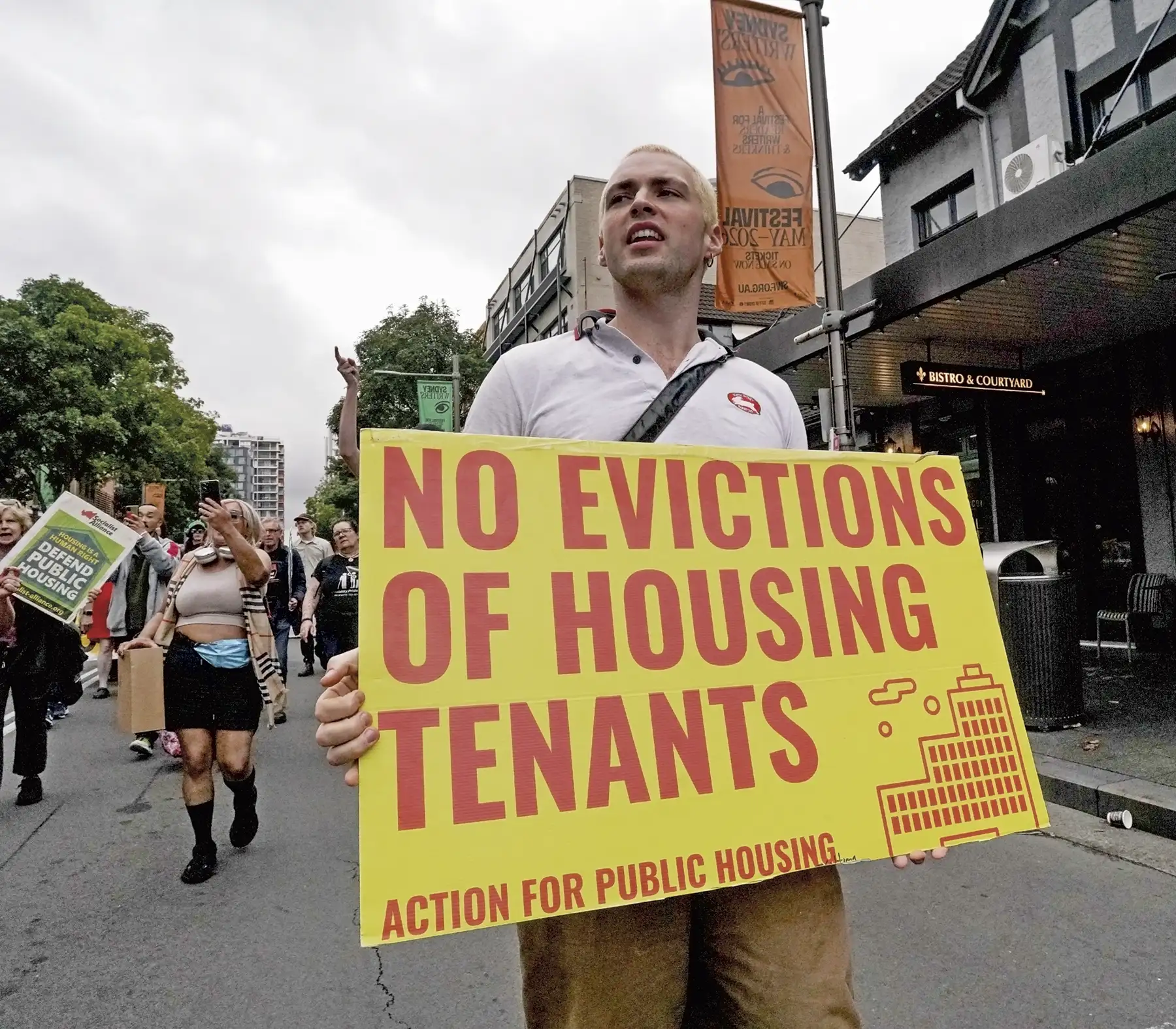
One of the most striking features of recent protests was the number of people speaking about Waterloo compared with the number of people actually living there.
Nobody disputes that genuine Waterloo residents were involved. They were.
Some have passionately opposed redevelopment for years.
Their voices deserve respect. But were the protests primarily tenant-led?
Or activist-led?
How many people attending rallies actually lived on the estate?
How many were housing campaigners, political activists, ideological organisers and professional advocates?
How many came because they opposed redevelopment in principle rather than because they were directly affected?
Because there is a difference. A significant difference.
There is a difference between a movement led by residents pursuing practical outcomes and a movement that uses residents as moral authority for a broader political project.
That does not automatically make the political project wrong. It does make scrutiny necessary.
Recent protest coverage often framed Waterloo not simply as a redevelopment dispute, but as a broader battle over privatisation, public land, capitalism, policing and government legitimacy.
Those debates may be important. But who exactly was being represented?
And who decided? When representation becomes performance, who checks the mandate?
What the Protesters Got Right
Before asking what the campaign may have got wrong, it is worth acknowledging what it got right.
Without public pressure, many resident concerns may never have received broader attention.
The protests brought media scrutiny. They forced political attention.
They raised important questions about relocation, public housing policy, community connections and the human consequences of redevelopment.
Many activists gave thousands of hours of unpaid effort. Many genuinely cared about residents. Many still do.
Some residents found comfort in knowing they were not facing uncertainty alone.
Those achievements matter. The question is not whether people cared.
I believe many did. The real question is whether the tactics that followed consistently advanced the interests of the residents they were intended to support.
Because good intentions and good outcomes are not always the same thing.
Was Waterloo Actually Broken?
One of the strangest political assumptions running through parts of the redevelopment debate was the idea that Waterloo itself needed fixing.
Not the lifts. Not ageing infrastructure. Not deteriorating buildings. The community.
At times, the conversation seemed to imply that Waterloo was somehow dysfunctional. That physical renewal required social renewal. That redevelopment was not merely about replacing buildings but about correcting a deeper problem.
But what if that assumption was wrong?
Waterloo was never just a collection of buildings. It was neighbours checking on neighbours.
Long-term friendships. Aboriginal community connections. Multicultural communities.
Informal care networks. Community organisations. Volunteers. People who knew each other’s names.
The buildings may have been ageing. The community wasn’t. A community is not its concrete. A community is its relationships.
Homes NSW and their Ministers should be careful not to confuse physical renewal with social failure.
But activists should be equally careful not to romanticise the existing estate as though significant renewal challenges did not exist.
Both realities can be true. Waterloo contained strengths worth protecting. And problems worth addressing. The challenge was never choosing one reality over the other. The challenge was holding both at the same time.
Why Were We Still Fighting a Battle That Had Moved On?
I opposed aspects of the sale of public land. Many others did too.
Reasonable people can disagree on whether governments should transfer public assets to facilitate mixed-tenure redevelopment.
But at some point, reality matters. The redevelopment debate has been running for more than a decade.
Governments have changed. Plans have changed. Consultations have come and gone.
The project is moving forward. The question today is not: “Should Waterloo be redeveloped?”
The questions are:
“How do we achieve the best outcomes for current and future residents?”
How do we protect vulnerable tenants?
How do we preserve community connections?
How do we ensure quality relocation support?
How do we reduce harm?
How do we create housing for future generations?
Those are the questions that matter now.
At what point does relitigating the past stop helping residents prepare for the future?
There is no doubt that protest can open a door. But somebody still has to walk through it. That means:
- Negotiation.
- Advocacy.
- Evidence.
- Solutions.
- Compromise.
- Accountability.
If protest becomes unwilling to move beyond opposition, it risks becoming a ritual rather than a strategy.
“Refurbish, Don’t Demolish” Sounds Simple. Is It?
One argument appeared repeatedly throughout the campaign. Don’t demolish. Refurbish. Repair. Upgrade.
It’s an attractive idea. Perhaps even the right one. But where was the evidence? Where was the independently costed alternative?
How many homes would a refurbishment provide? What would it cost? How long would the buildings remain viable? How many residents would still require temporary relocation? How would accessibility standards be improved? How would future housing demand be met? How many additional social housing homes would refurbishment create?
These are not rhetorical questions. They are the questions any serious alternative must answer.
Because saying “don’t demolish” is not a housing strategy. It is the beginning of a housing strategy.
An alternative is only an alternative when somebody has done the maths. Residents deserved more than slogans. They deserved competing plans.
When Did Fear Become a Community Engagement Strategy?
This is perhaps the most uncomfortable question of all.
Whether intended or not, there often appeared to be a growing gap between what many residents needed and what many activists were offering.
Residents needed certainty, practical information, support, advocacy and help navigating complexity.
Instead, many were exposed to constant narratives of crisis, catastrophe, betrayal and impending disaster.
Again and again, they heard words like:
- Eviction
- Demolition
- Privatisation
- Displacement
- Destruction
For some residents already carrying significant stress and uncertainty, the impact appeared real.
Anxiety seemed to rise. Confusion seemed to rise. Fear seemed to rise.
I am not suggesting this was deliberate. But intentions do not erase outcomes.
Did the protests reduce anxiety? Or amplify it? Did residents leave meetings with greater clarity? Or greater fear?
A campaign can be morally sincere and still be practically harmful.
That possibility deserves examination.
When Did Community Housing Become the Villain?
Another troubling aspect of the debate was the repeated conflation of very different concepts.
- Public housing.
- Social housing.
- Community housing.
- Private housing.
- Private developers.
They are not the same thing. Yet much of the public discussion on both sides treated them as interchangeable.
There are legitimate debates about public ownership. There are legitimate concerns about accountability. There are legitimate questions about government policy.
But community housing providers are not-for-profit organisations. They are not the same thing as commercial developers.
Residents deserve clear language. Public housing, social housing and community housing are related. They are not interchangeable.
If a campaign depends on blurring distinctions, perhaps it deserves closer scrutiny.
The stronger the argument, the less it should need oversimplification.
When Did Solidarity Become Hostility?
For years, residents, community leaders, service providers and local police worked to improve relationships in Waterloo.
Not because police are perfect. Far from it. But healthy communities require functioning relationships between residents, services and institutions. Trust takes years to build and only minutes to damage.
Criticising policing is legitimate. Questioning police conduct is legitimate.
Holding institutions accountable is legitimate. But demonising every police officer and calling them “pigs” is not a strategy. It is a slogan and an insult, and neither builds communities.
Anti-police rhetoric may generate applause in activist circles. But what does it achieve?
What message does it send to elderly residents? To domestic violence victims?
To vulnerable people who rely on positive relationships with local police?
Communities need accountability. But they also need trust.
Destroying one in pursuit of the other rarely ends well.
Homes NSW Must Answer Questions Too
None of this lets Homes NSW off the hook, far from it. It also does not mean their approach has been static. There have been efforts, and there has been a vast improvement in how Homes NSW has approached engagement in more recent stages. That must and should be acknowledged.
But improvement does not wipe out the damage already done. For years, residents lived with uncertainty, poor communication, changing timelines and conflicting messages.
Trust was not built. And where trust is absent, other voices fill the vacuum. Homes NSW needs to understand and empathise with that reality, not simply defend against it.
Security was visible. Compliance was visible. Conflict was visible.
Meaningful relationship-building and co-design were often less visible.
The obvious question is simple.
Why wasn’t there more investment in trust-building, mediation and genuine community conversation before tensions reached breaking point?
If Homes NSW wanted residents to trust the process, it needed more than information sessions, letters, fencing and formal communications.
It still needs sustained human engagement: two-way dialogue, joint decisions, less defensiveness and more visible effort to repair trust. Poor engagement creates fertile ground for outrage. The government should reflect seriously on that reality and devote more effort to addressing the harm caused by uncertainty and weak communication.
Homes NSW was not operating in a vacuum. Governments and ministers from multiple political parties contributed to delays, uncertainty and confusion through changing directions, shifting priorities and political intervention. Residents were often caught in the middle while decisions changed around them. If accountability matters, it must reach beyond the agency and include the political leaders whose decisions helped create the conditions residents experienced.
The Rise of Webcam Activism
Perhaps nothing symbolises modern activism more than the constant presence of cameras.
Every conversation is filmed. Every confrontation is recorded.
Every disagreement becomes content. Every emotional moment becomes social media material.
At times, it appeared that documenting activism became almost as important as undertaking it.
A question worth asking: Were some people trying to solve a problem, or document themselves solving a problem? There is a difference.
The moment a movement becomes more focused on producing footage than on producing outcomes, something has gone wrong.
Visibility matters. Documentation matters. Accountability matters.
But communities are not stages. Residents are not content.
And hardship should never become somebody else’s branding strategy.
How Do We Measure Success?
This is the credibility test. Not just for protesters. For everyone.
Government. NGOs. Politicians. Community organisations. Activists.
Headlines do not measure success. Likes do not measure success.
Livestream views do not measure success.
Outcomes measure success. Did residents receive better support?
Did understanding improve? Did anxiety reduce? Did relocation processes improve?
Did trust increase? Did residents become better prepared for change? And perhaps the biggest question of all: What exactly was achieved?
Not what was opposed. What was achieved?
What concessions were won? What commitments were secured? What changed for residents because of the campaign?
If nobody can answer those questions clearly, people are entitled to ask whether all that energy was directed in the right place.
If a movement cannot explain what victory looks like, it should not be surprised when people question whether it is winning.
Good Protest and Bad Protest
A good protest is honest. Evidence-based. Focused. Strategic.
A good protest creates leverage. A good protest secures concessions. A good protest improves outcomes. A good protest respects the agency of the people it claims to represent.
Bad protest confuses issues. Bad protest rewards outrage. Bad protest mistakes attention for progress. Bad protest creates enemies everywhere. Bad protest becomes addicted to conflict.
The purpose of protest is not to feel righteous. The purpose of protest is to achieve change. A protest that cannot define success risks becoming a movement dedicated to continuing the fight.
The Question Nobody Wants to Answer
If redevelopment stopped tomorrow, then what?
What is the alternative? Not the objection. The alternative.
How would ageing housing stock be renewed?
How would future demand for social housing be met?
How would accessibility be improved?
How would funding be secured?
How would additional housing be delivered?
How would the housing crisis be addressed?
Because opposing something is easy.
Building something better is harder.
Communities deserve answers. Not just resistance. Not just outrage. Not just solidarity as a brand. Actual answers.
Final Thought
I am not writing this because I support or oppose redevelopment. Read our submissions for that.
I am writing it because I care about what happens when communities become secondary to the conflict surrounding them.
Waterloo was never a battlefield. It was a neighbourhood.
Somewhere along the way, too many people became invested in winning the argument.
Not enough remained focused on helping the people who had to live with the outcome.
That applies to the government.
That applies to activists.
That applies to institutions.
That applies to all of us.
The people of Waterloo deserve better than government spin.
They deserve better than activist theatre.
They deserve better than endless outrage.
Most importantly, they deserve honesty.
Because credibility is not measured by how loudly you shout.
It is not measured by how many cameras you carry.
It is not measured by how many headlines you generate.
Outcomes measure it.
It is measured by trust.
It is measured by whether the people you claim to stand beside are actually better off because you stood there at all.
And that is the question Waterloo should now be asking of everyone.
This is not about dismissing any one group. It is about asking all of us — government, services, advocates, activists, and institutions — to be honest about whether our actions improved residents’ lives.




Leave a Reply